
First off, I would like to say thank you to those of you who follow our blog on at least a semi regular basis. We are able to keep the blog going because of you!! However, we have a new website and we are going to continue this blog on there. With the new site there is more information, content, and space to provide you with news, weather, and sports. It's like a completely different country compared to our old site. It is very simple and easy to navigate so I think the other station's sites pale in comparison. We will be trying to transfer some of our most recent posts over to the new blog so you guys can reference some of our old posts, but give us a few days cause it takes a while. Other then that, this will be the last post on the blogger site. So delete this bookmark and add our new weather blog. Here is the link; KDLT WEATHER BLOG. Thanks again for watching and reading. If you have any questions or comments, it has never been easier to contact us. Just go to the "Contact KDLT" tab at the top of any page at our website and you can ask or say anything you want. Enjoy the new site!!
~KDLT Meteorologist Cody Matz
Friday, January 29, 2010

Thursday, January 28, 2010
The Weather-people are Always Wrong...Maybe Not Always
I'm not the first to admit that we can be wrong when we tell you the forecast on air. But keep in mind while many science fields there is a right and a wrong way of doing things, with weather, forecasting is nowhere near an exact science, and thus we will not always be 100% accurate on the forecast. One of the main reasons we can be a bit off on the forecast is because we don't have an accurate idea of what's going on across the entire atmosphere to begin with. We take current observations and current data in account when we are forecasting, if the current data is wrong, we can't accurately tell where storm systems will move. So if everyone on the Earth would take weather data and send it into a huge supercomputer, we'd have a much better idea of a starting point. 
"The highly specialized twin turbofan jet will be stationed at Yokota Air Force Base in Japan through February before repositioning to Honolulu in March. From these locations, the aircraft will be tasked by the National Centers for Environmental Prediction — a division of NOAA’s National Weather Service — to fly into data sparse regions to collect information such as wind speed and direction, pressure, temperature and humidity. This data will be sent via satellite to global operational weather forecasting centers — and fed into sophisticated computer forecast models.
“These flights will help us better observe and understand the current state of the atmosphere over the Pacific, where most of North America’s weather originates, in order to better predict future conditions across the U.S. and Canada three to six days in advance,” said Louis Uccellini, Ph.D., director of the National Centers for Environmental Prediction in Camp Springs, Md.
These computer model improvements will play an essential role in meteorological support for the Winter Olympics in Vancouver in addition to more precise precipitation forecasts along the U.S. West Coast and points further east.
NOAA incorporated the Japan-based missions into its annual Winter Storms Reconnaissance program in early 2009 — flying 332 flight hours and logging miles equivalent to circling the Earth five times. Prior to 2009, missions were flown from Alaska, Hawaii and the U.S. West Coast. By expanding the reach across the International Date Line to Japan, NOAA is essentially pushing farther upstream to observe areas of interest with greater lead times.
These missions showed significant positive impact to global numerical weather prediction models, increasing both accuracy and lead times for high-impact weather events. For example, model forecasts of precipitation amounts improved, on average, 10 to 15 percent.
The high altitude, high speed NOAA Gulfstream IV is based at the NOAA Aircraft Operations Center, located at MacDill Air Force Base in Tampa, Fla.NOAA understands and predicts changes in the Earth's environment, from the depths of the ocean to the surface of the sun, and conserves and manages our coastal and marine resources. "
I like to compare it to directions - if someone gives you directions to a location, it's easy to get there, but if they give you directions from an unknown starting location, how are you going to get there? So the more accurate of a starting location you have, the easier it is to get to where you are going. Same story with weather, the more accurate of a starting location (or state of the atmosphere/surface & upper air observations) the more accurate of a forecast we will have. But even if we were to have everyone on Earth send in all this starting weather data, we still would be completely in the dark with systems coming in from the oceans.
That's changing however. Currently there are several ways to take observations out at sea, many of them being with weather buoys. The National Data Buoy Center has several of these planted all around the world to take current observations at the surface, so we can get a a better idea of what kind of systems are going to be moving onshore.
  Their website is extremely interactive, you can click on any of the buoys for the information.
 As you can tell, there are several areas where there are no buoys, and thus no data. The big change in ocean observations is coming via jet. Here's a look at NOAA’s Gulfstream IV aircraft. This jet is known best for taking weather observations in Atlantic hurricanes, but now it's going to be taking weather observations over the Pacific Ocean to help improve winter storm forecasts.
 (Credit: NOAA)
The National Data Buoy Center has several of these planted all around the world to take current observations at the surface, so we can get a a better idea of what kind of systems are going to be moving onshore. Their website is extremely interactive, you can click on any of the buoys for the information. As you can tell, there are several areas where there are no buoys, and thus no data. The big change in ocean observations is coming via jet. Here's a look at NOAA’s Gulfstream IV aircraft. This jet is known best for taking weather observations in Atlantic hurricanes, but now it's going to be taking weather observations over the Pacific Ocean to help improve winter storm forecasts.(Credit: NOAA)Here's what the National Oceanic and Atmospheric Administration says about this new addition into gathering current conditions:
"The highly specialized twin turbofan jet will be stationed at Yokota Air Force Base in Japan through February before repositioning to Honolulu in March. From these locations, the aircraft will be tasked by the National Centers for Environmental Prediction — a division of NOAA’s National Weather Service — to fly into data sparse regions to collect information such as wind speed and direction, pressure, temperature and humidity. This data will be sent via satellite to global operational weather forecasting centers — and fed into sophisticated computer forecast models.
“These flights will help us better observe and understand the current state of the atmosphere over the Pacific, where most of North America’s weather originates, in order to better predict future conditions across the U.S. and Canada three to six days in advance,” said Louis Uccellini, Ph.D., director of the National Centers for Environmental Prediction in Camp Springs, Md.
These computer model improvements will play an essential role in meteorological support for the Winter Olympics in Vancouver in addition to more precise precipitation forecasts along the U.S. West Coast and points further east.
NOAA incorporated the Japan-based missions into its annual Winter Storms Reconnaissance program in early 2009 — flying 332 flight hours and logging miles equivalent to circling the Earth five times. Prior to 2009, missions were flown from Alaska, Hawaii and the U.S. West Coast. By expanding the reach across the International Date Line to Japan, NOAA is essentially pushing farther upstream to observe areas of interest with greater lead times.
These missions showed significant positive impact to global numerical weather prediction models, increasing both accuracy and lead times for high-impact weather events. For example, model forecasts of precipitation amounts improved, on average, 10 to 15 percent.
The high altitude, high speed NOAA Gulfstream IV is based at the NOAA Aircraft Operations Center, located at MacDill Air Force Base in Tampa, Fla.NOAA understands and predicts changes in the Earth's environment, from the depths of the ocean to the surface of the sun, and conserves and manages our coastal and marine resources. "
So hopefully we'll get a little better at forecasting those winter storms further out in the forecast.
Keep warm today!
~KDLT Meteorologist Jesse Ritka
Wednesday, January 27, 2010
Coldy is Back!
The bitter cold has returned to the area like I told you it would yesterday. Wind chill advisories are posted for much of the east for wind chills 15 to 30 degrees below zero overnight tonight and into Thursday morning. Good news for Thursday though as the winds will settle down and we will see lots of sunshine. But highs are going to struggle, staying in the single digits and low teens.
Good news for Thursday though as the winds will settle down and we will see lots of sunshine. But highs are going to struggle, staying in the single digits and low teens.As for the title of this posting, those of you that watched the 6pm newscast a few weeks ago, Jessica stumbled as she was saying my name and it came out as coldy. Now this was appropriate at the time because it was extremely cold. But now every time it's going to be cold outside, everyone calls me coldy. It's amazing the things that catch on! Stay warm!!
~KDLT Meteorologist Cody (Coldy) Matz
Tuesday, January 26, 2010
Staying Cold
We are finally rid of another storm and it actually looks like we have some dry weather ahead, at least for a little while. We are slipping into a drier and colder pattern for the next few days. The good news with that, we will see lots of sunshine. The bad news for those of you looking to shed your heavy winter coat, is that temperatures look to stay quite chilly through at least the end of the week. Here is a look at temperatures at the 850mb level tomorrow afternoon and Thursday afternoon.
 Remember that these temperatures are about 5000 feet in the air. But this gives us a good look at just how cold the surface will be. It is going to be breezy on Wednesday, but that will help temperatures stay a bit warmer because mixing helps warm the atmosphere. But Thursday looks calmer and colder with highs some 20 degrees below average.
 Probability of seeing precipitation above or below average 8-14 days from today:
 Looks like that temperatures and precipitation will be near normal overall in that time frame. The good news is they (CPC) are not seeing any major storm systems moving through our area in the next 14 days. However, that can change so just keep your fingers crossed and maybe we can get through the next few weeks with no major weather makers.
Remember that these temperatures are about 5000 feet in the air. But this gives us a good look at just how cold the surface will be. It is going to be breezy on Wednesday, but that will help temperatures stay a bit warmer because mixing helps warm the atmosphere. But Thursday looks calmer and colder with highs some 20 degrees below average. In case you are wondering what is in store for us after the next 7 days, here's a preview. The Climate Prediction Center issues forecast for probabilities of being above or below average in temperature and precipitation. Here they are;
Probability of seeing temperatures above or below average 8-14 days from today:
Probability of seeing precipitation above or below average 8-14 days from today:Looks like that temperatures and precipitation will be near normal overall in that time frame. The good news is they (CPC) are not seeing any major storm systems moving through our area in the next 14 days. However, that can change so just keep your fingers crossed and maybe we can get through the next few weeks with no major weather makers.~KDLT Meteorologist Cody Matz
Interstates Opening
I-90 is now open state-wide, and I-29 is open from the southern border to Brookings, I-29 remains closed at this moment from Brookings to the North Dakota border. Here's a look at why:  But crews are out trying to clear the roads... you can see that 2 hours later (at 7:20 when this picture was captured on the same camera) the drift is gone and there's just a bit of water left where the snow drift was.
 Keep tuned onto KDLT, we'll update the closings ticker on the bottom of the screen throughout the day with more updates about the interstates.
This picture was captured on the DOT street cameras (accessed through www.safetravelusa.com/sd) around 5:20 this morning. I circled the snow drift that takes up most of the road.
But crews are out trying to clear the roads... you can see that 2 hours later (at 7:20 when this picture was captured on the same camera) the drift is gone and there's just a bit of water left where the snow drift was.Keep tuned onto KDLT, we'll update the closings ticker on the bottom of the screen throughout the day with more updates about the interstates.Stay safe on the roads, winds will be diminishing today, so enjoy some more mild weather this week... just bundle up since it will be colder than normal.
~KDLT Meteorologist Jesse Ritka
Monday, January 25, 2010
Blizzard Today
The fourth blizzard this season is making its way through the region and causing some big problems for travelers as white out and near white out conditions could be found all across the region. Here are just a few pictures from this storm.


 Roads are nearly impassable in many spots because of blowing snow and drifting. Here are the current road conditions.
 No travel is advised East of the Orange dashed line so just sit tight wherever you are and wait till morning to venture out.
Roads are nearly impassable in many spots because of blowing snow and drifting. Here are the current road conditions.No travel is advised East of the Orange dashed line so just sit tight wherever you are and wait till morning to venture out.~KDLT Meteorologist Cody Matz
A Blustery, Blustery Day
We've still got snow showers left over this morning from the weekend storm system, they are still wrapping around the area of low pressure that has moved off to our east, so expect these snow showers to follow suit and decrease from west to east this afternoon. The winds are going to cause wicked problems today. They will be strongest this morning and into the afternoon hours, gusting up to 50mph. This will cause the falling snow to blow around, reducing visibilities. Here's a brief breakdown of your wind forecast: Things will taper off a little later this evening, but the windy conditions will continue to cause blowing snow and reduce visibilities.
 The winds will die down by Tuesday afternoon and the snow will have stopped by then, so we're looking at a more calm forecast from then on.
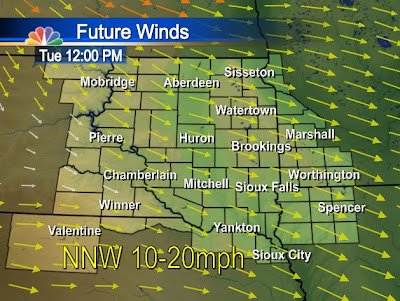 These winds are all from the northwest, so naturally they will bring colder weather into the forecast. Expect single digits near zero, some folks in the northeast may dip below zero tonight, which will set the stage for a colder work week.
Things will taper off a little later this evening, but the windy conditions will continue to cause blowing snow and reduce visibilities. The winds will die down by Tuesday afternoon and the snow will have stopped by then, so we're looking at a more calm forecast from then on.
 These winds are all from the northwest, so naturally they will bring colder weather into the forecast. Expect single digits near zero, some folks in the northeast may dip below zero tonight, which will set the stage for a colder work week.
Bundle up,
~KDLT Meteorologist Jesse Ritka
Sunday, January 24, 2010
Winds of Change, Really...
If you haven't stepped outside that should of not stopped you from noticing how windy its been lately. We have sustain winds near 40 mph in some locals, and gusts over 50 mph! With the snow that's falling and the fresh snow covering the ground, those winds sure make it seem like blizzard conditions out there. There are no blizzard warnings out for any areas, only wind advisories. These winds will plague the area till Monday evening, when we notice calmer breezes for Tuesday. As of Sunday evening here's what the sustained winds looked like:
 Here's the strong Wind gusts:
 What we can expect to see Monday morning when the winds should be at their strongest. This is when gusts can exceed 50 mph in all locations.

 These winds are bringing in much cooler air also, highs in the teens for Tuesday and Wednesday, but that will seem warm compared to what we can expect for Thursday! Stay warm and enjoy this cold week coming up (the sun will seem nice)!
Here's the strong Wind gusts:What we can expect to see Monday morning when the winds should be at their strongest. This is when gusts can exceed 50 mph in all locations. Since the strong winds are forecasted to hang out in South Dakota, the NWS has issued high wind advisories through the night on Sunday and all day Monday, not expiring till Monday at 9pm, but a few counties will expire those advisories at 6pm (mainly up north). All the brown on the map (most of South Dakota) are your high wind advisories.
These winds are bringing in much cooler air also, highs in the teens for Tuesday and Wednesday, but that will seem warm compared to what we can expect for Thursday! Stay warm and enjoy this cold week coming up (the sun will seem nice)!~KDLT Meteorologist Dan Bronis
Subscribe to:
Posts (Atom)